-1.png?width=1182&height=222&name=TSS_alternate_logo_v1b%20(long)-1.png "TSS_alternate_logo_v1b (long)-1")

For decades, research into Parkinson’s Disease (PD) has felt like trying to solve a complex puzzle with missing pieces. While treatments exist to manage symptoms, scientists have been relentlessly searching for the underlying cause—the "why"—of the neurodegeneration that defines the condition.
Today, a significant new piece of that puzzle was found.
Researchers have announced the discovery of a specific ion channel within our cells that acts as an "overflow valve." When this valve malfunctions, it appears to be a major driver of the cellular damage seen in Parkinson’s. This finding is being hailed as a potential "game-changer" that could shift the landscape of Parkinson’s treatment from managing symptoms to prevention at the cellular level.
The Problem: The Cell’s Cluttered Recycling Center
To understand this breakthrough, we first need to look at how our cells clean themselves. Inside every cell are tiny structures called lysosomes. You can think of lysosomes as the cell’s recycling centers or garbage disposal units. Their job is to break down and recycle waste proteins and other cellular debris.
In Parkinson’s Disease, something goes wrong with this process. The recycling centers stop working efficiently. As a result, toxic waste—specifically a protein called alpha-synuclein—begins to build up inside the brain cells (neurons). This "clutter" eventually becomes too much, causing the cells to dysfunction and die, leading to the movement and cognitive symptoms of PD.
But why do the lysosomes fail? That’s the question scientists have been desperate to answer.
The Discovery: The TMEM175 "Overflow Valve"
The research announced today points to a culprit: a specific protein channel called TMEM175.
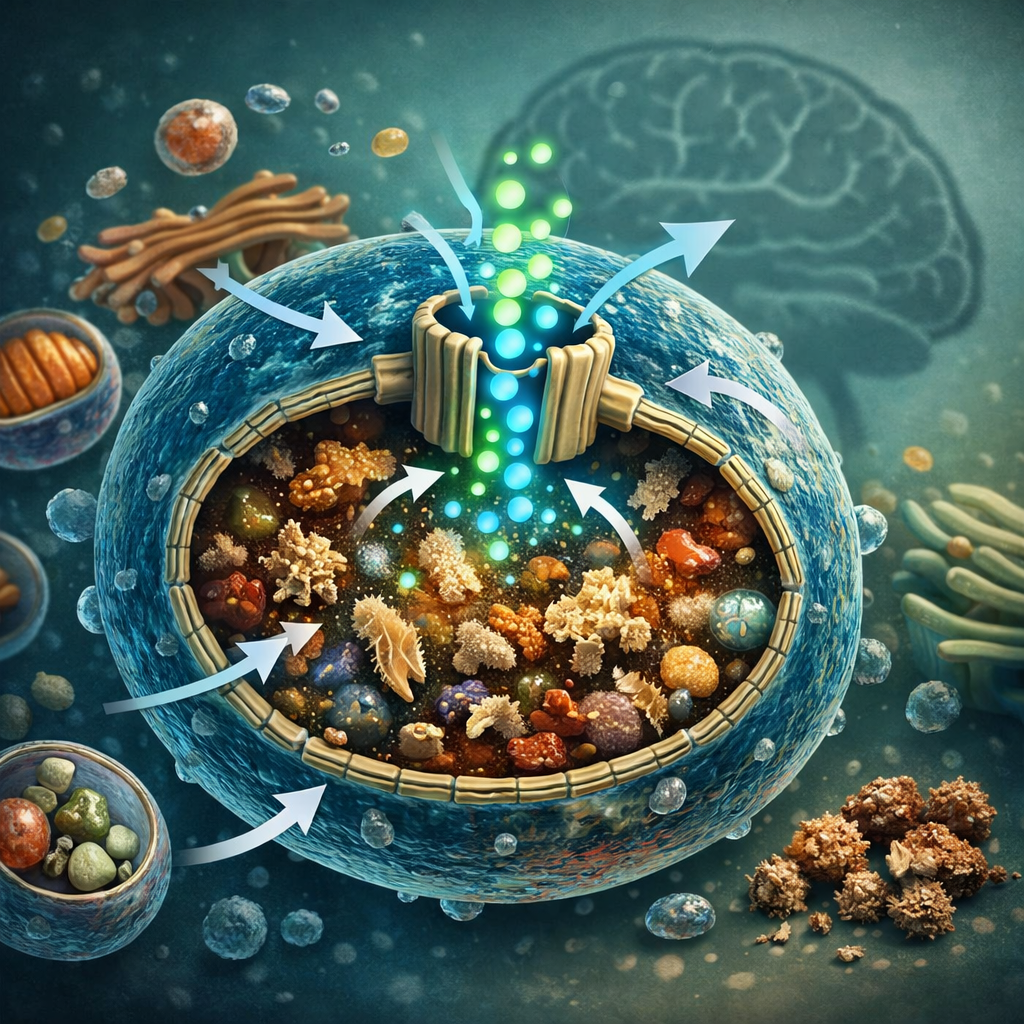
This protein sits on the surface of the lysosome, functioning as an ion channel. Until now, its exact role was unclear. This new study, however, reveals that TMEM175 acts precisely like an "overflow valve" for the lysosome.
In a healthy cell, when the lysosome is working hard and its internal environment becomes too charged or overloaded, the TMEM175 valve opens. This releases ions, relieving the pressure and allowing the lysosome to continue its vital recycling work without interruption.
What Happens When the Valve Fails
The crucial finding is that in many cases of Parkinson’s, this "overflow valve" (TMEM175) is either faulty, damaged, or entirely absent.
When the valve doesn't work:
- Pressure Builds: The lysosome cannot relieve the internal pressure created during waste processing.
- Recycling Stops: The lysosome becomes inefficient and stops breaking down waste effectively.
- Toxic Buildup: The "garbage" (including alpha-synuclein) backs up and overflows into the cell.
- Cell Death: This toxic accumulation damages the neuron, ultimately leading to the cell death that characterizes Parkinson’s.
This discovery provides the first direct link showing how a specific cellular defect—the faulty valve—directly causes the waste buildup that drives the disease.
Why This Is a Game-Changer
This is not just another incremental discovery. The identification of TMEM175 is profoundly significant for several reasons:
1. A Precision Target for New Drugs Previous Parkinson’s treatments have often been "one-size-fits-all," primarily replacing the dopamine lost when cells die. This discovery gives drug developers a precise, concrete target. The new mission is clear: Find a molecule that can "fix" or activate the faulty TMEM175 valve.
2. Focus on Prevention, Not Just Treatment By targeting TMEM175, researchers believe they can stop the toxic waste buildup before it damages the cell. This moves treatment from the realm of symptom management to true disease-modifying therapy. If we can keep the "recycling center" running smoothly, we might be able to slow, halt, or even prevent the progression of Parkinson’s in its early stages.
3. Potential for Personalized Medicine In the future, a simple test might determine if a patient’s Parkinson’s is driven by a TMEM175 deficiency. This would allow doctors to prescribe therapies specifically designed to repair that user's cellular "plumbing," leading to more effective, personalized care.
The Path Forward
It is important to remember that while this is an extraordinary breakthrough, it is still the first step. Developing new drugs that can safely target TMEM175 in the human brain will take years of rigorous testing and clinical trials.
However, the path forward has never been clearer. For the millions of people living with or at risk for Parkinson’s, the discovery of the TMEM175 "overflow valve" offers a powerful new source of hope: the hope that we are finally closing in on the root cause of this disease, and the hope of a future where its progression can be stopped.
The TMEM175 Discovery (Parkinson's)
- Primary Source: ScienceDaily / Ludwig-Maximilians-Universität München (LMU).
- Article Title: "Scientists discover 'overflow valve' in cells linked to Parkinson's Disease."
- Date: March 26, 2026 (based on the latest research by Professor Christian Grimm and Dr. Oliver Rauh published in PNAS).
- Core Finding: Deciphered that the TMEM175 ion channel acts as a pH regulator (overflow valve) in lysosomes, preventing the toxic waste buildup (alpha-synuclein) that kills neurons.
.png?width=160&height=90&name=cdn%20(1).png "cdn (1)")