-1.png?width=1182&height=222&name=TSS_alternate_logo_v1b%20(long)-1.png "TSS_alternate_logo_v1b (long)-1")

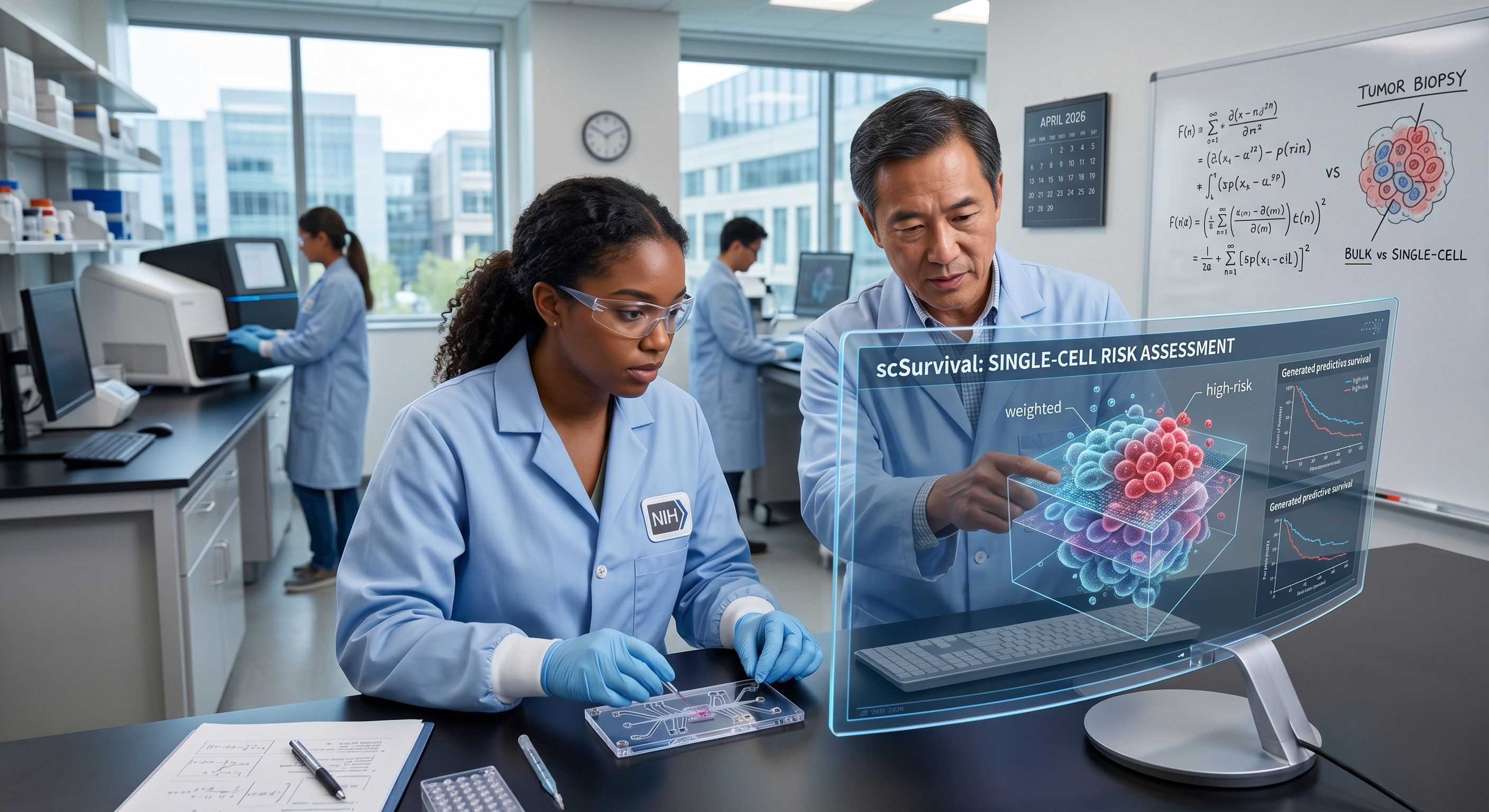
In the world of oncology, "average" is often the enemy. For decades, doctors have relied on tumor biopsies that are "blended"—meaning the data from millions of cells are averaged together to create a single profile. This approach often erases the "bad actors"—those few, high-risk cells that actually drive cancer progression.
That changed on April 21, 2026, when NIH-funded researchers at Oregon Health & Science University (OHSU) debuted scSurvival, a first-of-its-kind AI model that analyzes tumors at a single-cell resolution to predict patient survival with unprecedented accuracy.
Beyond the "Blender" Approach
Traditional tumor analysis is like looking at a satellite photo of a city; you see the overall layout, but you can’t see what’s happening in an individual house. scSurvival, however, walks right through the front door of every single cell.
Developed by a team led by Zheng Xia, Ph.D., and published in the journal Cancer Discovery, the model uses a sophisticated machine learning framework to assign a "weight" to individual cells based on their relationship to survival. Instead of treating every cell as equal, the AI filters out the "noise" of healthy or less-impactful cells to focus on the specific populations that dictate a patient's risk.
Precision at the Cellular Level
The researchers tested scSurvival on clinical data from more than 150 patients with melanoma and liver cancer. The results were staggering:
- Superior Accuracy: The AI predicted outcomes more accurately than traditional gene expression or histological (imaging) methods.
- Identified "High-Risk" Residents: It successfully pinpointed specific immune and tumor cell populations linked to better or worse survival.
- Immunotherapy Guidance: In melanoma cases, the tool identified cell groups that directly influenced how a patient would respond to immunotherapy, allowing doctors to know before starting treatment if it is likely to work.
Why This Matters for Patients
The ability to predict survival and treatment response from a single-cell tumor biopsy moves the needle from "one-size-fits-all" to "one-size-fits-you."
When a doctor can identify the exact cell population causing a tumor to be aggressive, they can tailor treatments—such as specific immunotherapies or targeted drug cocktails—much more precisely. It reduces the "trial and error" phase of cancer care, which is often the most physically and emotionally taxing part of the journey.
The Future of scSurvival
While the tool is currently a research powerhouse, the OHSU team has made the scSurvival program open-source, meaning it is now available for researchers worldwide to refine and integrate into clinical settings.
"A risk assessment tool that not only tells you who may be at higher risk, but also provides clues as to why, could really help in these difficult cancers," said Anthony Letai, M.D., Ph.D., director of the NIH’s National Cancer Institute (NCI).
As we look toward the second half of 2026, the integration of AI like scSurvival into routine pathology could mark the moment we finally stop treating the cancer type and start treating the specific cellular signature of the individual patient.
Primary Scientific Sources
- Cancer Discovery (Journal Article): Ren, T., Zhao, F., et al. (2026). "scSurvival: Single-Cell Survival Analysis of Clinical Cancer Cohort Data at Cellular Resolution." Senior Author: Zheng Xia, Ph.D. Published April 21, 2026. [DOI: 10.1158/2159-8290.CD-25-0965]
- AACR Annual Meeting 2026: Research Presentation: "AI Revolution in Cancer Research: Implementing scSurvival in Clinical Cohorts." Presented at the American Association for Cancer Research (AACR) Conference, April 21, 2026.
Institutional & Governmental Sources
- OHSU News Release: "New cancer research tool predicts patient survival at single-cell resolution." Oregon Health & Science University (April 21, 2026). This provided details on the collaboration between the OHSU Knight Cancer Institute and the OHSU School of Medicine.
- National Cancer Institute (NCI) / NIH Statement: Official commentary by Anthony Letai, M.D., Ph.D., Director of the National Cancer Institute, regarding the tool’s ability to provide "mechanistic clues" about tumor biology to improve risk assessment.
- NIH Office of Portfolio Analysis: Project data regarding NIH-funded precision oncology grants awarded to the OHSU Biomedical Engineering Department (2024–2026).
Medical News & Industry Reporting
- Medical Economics - Morning Medical Update: "AI model predicts cancer survival from single-cell tumor model" (April 22, 2026). This source focused on the clinical implications for personalized immunotherapy.
- BioEngineer.org: "NIH-Backed AI Model Forecasts Cancer Survival Using Single-Cell Tumor Analysis" (April 22, 2026). This provided technical details on the variational autoencoder-based feature extraction module used in the AI framework.
.png?width=160&height=90&name=cdn%20(1).png "cdn (1)")